
News Topic
Tehran says diplomacy continues amid ongoing attacks over control of Strait of Hormuz
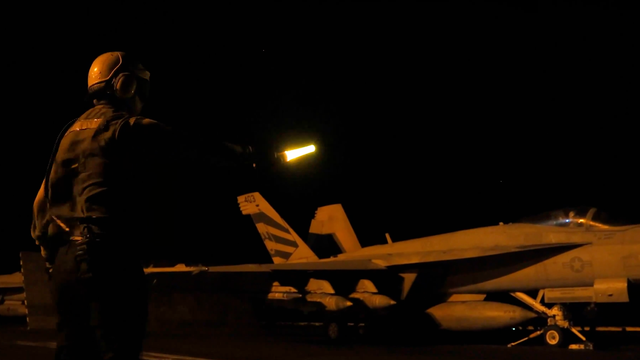
What to know about the Iran war today:
o Iran claimed attacks Monday on Persian Gulf countries that host U.S. military bases after another round of U.S. strikes the previous evening, as renewed fighting over control of the Strait of Hormuz continued into a second week.
o U.S. Central Command said Sunday that forces targeted various Iranian vessels and facilities, and it contradicted Tehran's claim that the Strait of Hormuz is closed, insisting that "Iran does not control" the vital shipping lanes.
o Oil prices shot up nearly 5% Monday after the weekend's strikes, with benchmark crude prices nearing $80 a barrel again after plunging briefly to pre-war levels.
16m ago
Bahrain army accuses Iran of targeting civilians
Bahrain's military on Monday accused Iran of targeting civilians with its latest attacks on the kingdom, after Tehran said it had struck U.S. military facilities and infrastructure there.
"Iran continues its systematic hostile approach through its heinous attacks with missiles and drones that target civilians in the Kingdom of Bahrain," the general command of Bahrain's military said in a statement, adding that air defences "intercepted and destroyed a number of Iranian aerial attacks" on Monday morning.
39m ago
Iran says it will not allow nuclear inspections
Iran said Monday it would not agree to a resumption of international inspections at some of the country's nuclear facilities.
In response to a question on whether Iran would accept theUnited Nations' International Atomic Energy Agency's (IAEA) request to access nuclear facilities, Foreign Ministry spokesman Esmail Baqaei said the regime would not.
The memorandum of understanding signed with the U.S. calls for negotiations to take place between both parties on the future of Tehran's nuclear program, but it doesn't bind the regime to any specific terms or schedule.
After the first of just two days of direct negotiations between U.S. and Iranian officials since the MoU was signed, Vice President JD Vance said he expected IAEA inspections to resume within days. But two days later, a senior Iranian negotiator said any such arrangements would only be solidified as part of a final agreement with the U.S.
The IAEA regularly carried out inspections and had cameras installed to monitor Iran's enrichment work for years under the previous nuclear deal negotiated by the Obama administration, known as the JCPOA.
Iran slowly denied that access in the wake of President Trump withdrawing the U.S. from the JCPOA during his first term, while ramping up its uranium enrichment to produce its first-ever near-weapons-grade material.
59m ago
Iranian media report blasts near Strait of Hormuz
Explosions of unknown origin were heard in southern Iran near the Strait of Hormuz on Monday, a news agency reported, following an exchange of attacks between Tehran and Washington.
"Media and residents reported having heard on Monday at midday explosions near Bandar Abbas and the island of Qeshm," the semi-official Mehr news agency said, adding that the blasts "appear to be coming from the West Coast of Bandar Abbas."
6:28 AM
Iran indicates indirect talks with U.S. will continue after calling talks "futile"
Iran said Monday it was continuing talks with mediators from Qatar, Pakistan and Oman in an effort to prevent any further escalation with the United States.
"The role of the mediators is to continue their efforts to prevent an escalation of tensions," said Iranian foreign ministry spokesman Esmaeil Baqaei, stressing that Tehran would pursue diplomacy along with military measures.
"Wherever necessary, we will use military means to defend our interests, and wherever circumstances require, wherever the country's interests dictate, we will use the tool of diplomacy," the spokesperson said.
Iran's foreign ministry said Sunday the latest wave of U.S. attacks on its territory had rendered recent diplomatic efforts "futile."
5:59 AM
Iran blames U.S. for recent escalation
Iran has blamed the U.S. for escalation of attacks over the last week over control of the Strait of Hormuz.
"Everything that has happened over the past several weeks, especially in the past few days, is the direct responsibility of the United States, because they cheated from the very first day," Esmail Baqaei, a spokesperson for Iran's foreign ministry, said Monday.
He claimed the U.S. did not allow Iran to carry out the work which would make the Strait of Hormuz safe to transit, as set out in the fifth clause of the memorandum of understanding, and instead created other routes in the waterway that Tehran claims are not safe.
The U.S. resumed major strikes on Iran on June 7, calling them retaliation for Iranian attacks on oil tankers in the Strait of Hormuz, which were hit in the south of the strategic waterway, near the Omani coast.
5:22 AM
UN chief warns of "catastrophic consequences" of fighting
The United Nations Secretary-General warned of "catastrophic consequences" for the region if fighting resumes.
"A return to full-scale hostilities would have catastrophic consequences - for the peoples of the region, for international peace & security & for the global economy," António Guterres said in a statement.
The UN chief expressed his concern for the recent escalation and said the attacks "must all stop."
4:51 AM
Oil prices jump after weekend of fighting over Strait of Hormuz
The price of Brent crude, the international standard, gained 4.7% to $79.59 per barrel, while U.S. benchmark crude oil added 4.8% to $74.85 per barrel.
Prices for both types of crude oil recently had slipped back to around the levels they were at before the war with Iran began, after the two sides set an interim agreement on ending the conflict and ships resumed transporting oil through the Strait of Hormuz.
However, the United States launched several waves of strikes on Iran into Monday morning over an Iranian attack on a container ship in the strait that set it ablaze and left a crew member missing over the weekend. Iran retaliated by targeting countries across the Middle East.
4:51 AM
Latest U.S. strikes have "rendered futile" recent diplomacy, Iran says
Iran has condemned the latest wave of U.S. attacks on its territory, saying they had "rendered futile" all the diplomatic efforts of the last few months.
The United States has also "caused the return of insecurity in the Strait of Hormuz and disruption of international commercial shipping by openly interfering in the process of Iran implementing the necessary arrangements in the Strait of Hormuz," a foreign ministry statement said Sunday.
4:51 AM
Iran attacks Bahrain, Oman and Jordan
Iran's Revolutionary Guards on Monday claimed strikes against Bahrain and Oman, saying they destroyed radar systems in Oman and targeted U.S. military facilities on the southern edge of Manama.
Additionally, the Jordanian military said on Monday it had shot down four Iranian missiles over the country, which Tehran said were intended as retaliation for U.S. strikes.
"At dawn today, air defence systems intercepted and shot down four missiles that had entered Jordanian airspace from Iranian territory," an official source from the Jordanian General Staff said, adding that there were no reports of injuries or damage to property.
4:51 AM
U.S. conducts more strikes on Iran
U.S. Central Command (CENTCOM) said it struck dozens of Iranian targets on Sunday.
"Forces struck Iranian military air-defense systems, coastal radar sites, missile and drone capabilities, and small boats using U.S. fighter aircraft, naval vessels, one-way attack aerial drones, and one-way attack sea drones for the first time," CENTCOM said in a statement.
It added that Iran "does not control" the Strait of Hormuz, in response to earlier claims by Tehran that the vital waterway was effectively closed.
Source
Posted by Temmy
Mon, July 13, 2026 12:57pm
| Top |
|
For enquiries, notifications and ad placement send mail to worldnewsservice2025@outlook.com Copyright 2019 - 2026 All Rights Reserved. Privacy Policy || Terms & Conditions |