
News Topic
Iran says strait won't open until the U.S. "corrects behavior"
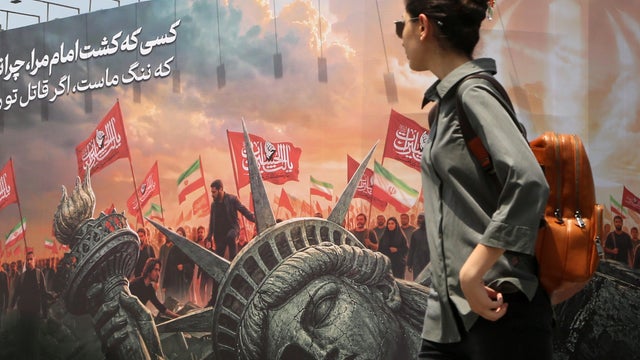
What to know about the Iran war today:
o Iran targeted a vessel owned by the Abu Dhabi National Oil Company in the Strait of Hormuz on Saturday, despite ongoing talks with Oman over how to manage the disputed waterway.
o Iranian Foreign Minister Abbas Araghchi on Saturday said talks with Oman were "approaching the final stages," but cautioned that "this is not a sign of the reopening of the Strait of Hormuz."
o The Supreme National Security Council of Iran issued a list of highly unlikely demands from the U.S. in order to fully reopen the Strait of Hormuz, saying the U.S. must never threaten Iran again, end the blockade, withdraw all military assets from the region, lift sanctions, unfreeze assets and compensate Iran for war damages.
34m ago
GOP Sen. Bill Cassidy says Trump needs to "come out and speak forcefully on what the path forward is" in Iran
GOP Sen. Bill Cassidy of Louisiana said President Trump needs to speak to the American public about the path forward in Iran, after diplomatic efforts collapsed and hostilities resumed in recent weeks.
In an appearance on "Face the Nation with Margaret Brennan" on Sunday, Cassidy noted that Vice President JD Vance attended a Senate GOP lunch last week, where Cassidy said Vance "did a good job of explaining the perspective as to how to go forward." The Louisiana Republican said someone else at the lunch told the vice president that the president needs to share the same message with the American people.
"And J.D. said, 'Well, the president has," Cassidy said. "I mean, they may have, but it's being kind of overwhelmed by everything else being said, and so I think the president needs to come out and speak forcefully on what the path forward is, and and at some point it may be that that that path forward works or not, but at least there needs to be that dialogue with the American people."
Cassidy reiterated the path forward that he said Vance outlined to the GOP senators, which he said involved putting pressure on Iran, like with blockades, to cause them "enough discomfort that they will actually come back to the bargaining table." Meanwhile, the strategy includes the U.S. working to blunt the effectiveness of Iran's efforts in the Strait of Hormuz by getting oil through.
"That continued economic pressure, while alleviating the pressure on the West, as well as continued selective operations, is part of a long-term strategy," Cassidy said. "It's not something that ends it tomorrow, but something which gradually brings it to a close."
9:23 AM
Netanyahu vows no Gaza withdrawal until Hamas disarms
Israeli Prime Minister Benjamin Netanyahu on Sunday rejected a U.S.-backed Gaza peace plan and vowed there would be no military withdrawal until Hamas is "genuinely" disarmed.
On Sunday, after more than a week of gradually escalating criticism of the plan, Netanyahu explicitly opposed it as he faced pushback from his right-wing base ahead of elections.
"Israel rejects the 15-point document," he said in a cabinet meeting, adding that the military "will not make any withdrawal until Hamas is truly disarmed and will continue to thwart threats against our forces and citizens."
Updated 9:21 AM
Iranian state TV releases undated footage of Khamenei
Iranian state media have released an undated video they claim shows Supreme Leader Ayatollah Mojtaba Khamenei. It is unclear when the footage was taken, and CBS News could not independently verify it.
If the video is recent, it marks the first time Iran's supreme leader appears to be seen since the war with the U.S. and Israel reignited in February. He reportedly sustained serious injuries during the opening stages of the war.
The absence of the ayatollah from the public eye since his father's death and his own ascension into power raised questions about his health and who exactly was running the country.
7:22 AM
Netanyahu vows Iran will 'not have nuclear weapons' with or without deal
Israeli Prime Minister Benjamin Netanyahu vowed Sunday to prevent Iran from having nuclear weapons, a goal he has long alleged Tehran is pursuing, regardless of the course of diplomacy with Washington and Arab states.
"I want to emphasise once again: with an agreement or without an agreement, as long as I am prime minister, Iran will not have nuclear weapons," Netanyahu said at a cabinet meeting.
6:25 AM
Houthis claim attack on crucial port on the Red Sea
A Yemeni government official said Sunday that the Iran-backed Houthi group also attacked a crucial port on the Red Sea.
Fayed al-Noman, assistant undersecretary of the information ministry, said the Houthis fired missiles and drones on the Mocha port. It's one of the main ports under Yemen's internationally recognized government, renovated in recent years to handle shipping that avoids the Houthi-held ports in Hodeida.
The Houthis later claimed the attack, saying they fired "a large number of ballistic missiles and drones" that targeted military enforcement and warehouses in the area.
5:00 AM
Iran insists it is not engaged in negotiations with the United States
Iran's Foreign Minister insisted on Sunday that Iran is not engaged in negotiations with the United States.
"Until the violations of the memorandum of understanding by the United States come to an end and the United States compensates for what it has violated, from our perspective, there is no possibility of resuming negotiations," Abbas Araghchi told Iran's Tasnim news agency.
Iran has been engaged in negotiations with Oman, the other country whose coastline includes part of the Strait of Hormuz, regarding the future management of the waterway. Araghchi on Saturday said talks with Oman were "approaching the final stages."
4:23 AM
Tehran insists Strait of Hormuz will be closed until U.S. accepts all demands
Iran's Revolutionary Guards on Sunday said they would not reopen the Strait of Hormuz until the United States accepts all of Tehran's demands.
"Our current strategy is to maintain this strait until the enemy accepts all our conditions," said Guards spokesman Hossein Mohebi, as quoted by state TV, adding that "the strait is now actually a theatre of war for us and not just a waterway".
3:12 AM
Houthis claim attack on Saudi refinery
Yemen's Iran-backed Houthi rebels claimed on Sunday an attack on an Aramco oil refinery in Saudi Arabia.
The group's spokesperson said they had "succeeded in targeting the Aramco refinery in Jazan with a drone, and the strike was precise."
Saudi Arabia's Ministry of Energy had earlier reported a fire at the facility in Jazan, adding that no injuries had been reported and the flames had been extinguished.
11:54 PM
Pentagon calls on U.S. defense industry to boost weapons production
The Pentagon is pressing the U.S. defense industry to accelerate production of weapons to help replenish its diminished stockpile of munitions, including those depleted in the ongoing war with Iran.
Pentagon spokesman Sean Parnell said in a statement Saturday that the department was actively focused on boosting munitions acquisitions to provide "the weapons our warfighters need at the pace the threat demands."
He confirmed department efforts in the last week to significantly speed the process but insisted it was part of a broader modernization effort that predated the five-month-old conflict.
Deputy Defense Secretary Steve Feinberg wrote to industry leaders on Wednesday, giving them no more than 21 days to submit plans to "drive significantly faster, more aggressive delivery schedules and/or increased production for critical capabilities," according to a memo obtained by The Washington Post.
"Years-long development cycles are not acceptable," Feinberg wrote. "We must dramatically accelerate our program schedules and expand our production capacity now."
Two sources with direct knowledge of the matter told CBS News earlier this week that the U.S. has used nearly all of its global stockpile of long-range precision missiles during the war with Iran.
Specifically, the U.S. has used virtually all of its Army Tactical Missile Systems, known as ATACMS, and Precision Strike Missiles, the sources said.
President Trump in recent days has bristled over public reports of a munitions shortage, posting on Truth Social on Thursday that the U.S. has "massive amounts." He added that "large amounts are being manufactured and shipped to the U.S. as needed."
On Saturday, Parnell affirmed that Feinberg's memo seeking a rapid escalation of weapons production is "real," adding that it "will inform the fiscal year 2028 budget submitted to Congress for funding, and it is entirely consistent with our ongoing push to rebuild the defense industrial base."
6:34 PM / August 8, 2026
Yemen's military conducts retaliatory attacks on Iran-backed Houthis
Yemen's military conducted retaliatory attacks Saturday on the Houthi militant group, an Iranian proxy.
The attacks were in response to the Houthis' recent strikes in central and eastern Yemen.
Col. Majed al-Nazili, spokesperson for Yemen's military, said the attacks targeted the rebels' "sites and capabilities" on multiple front lines, without elaborating.
The escalation between the Houthis and Yemen's internationally recognized government and its backer, a Saudi-supported coalition, threatens to reignite Yemen's civil war following a 2022 truce.
3:04 PM / August 8, 2026
U.S. blockade has redirected 53 ships in Strait of Hormuz, military says
The renewed U.S. blockade on the Strait of Hormuz has redirected 53 ships trying to enter or exit Iranian ports, according to U.S. Central Command.
The total is an increase of two ships since yesterday. The blockade was reinstated on July 14 after Iran targeted ships in the strait and a ceasefire between the two sides fell apart. The first blockade had redirected over 140 ships from April 14 to June 18.
Central Command also noted it has let through more than 30 ships carrying humanitarian aid, a number it does not regularly release.
On Saturday, Mohammad Bagher Zolghadr, a member of Iran's Supreme National Security Council, issued a string of demands for the strait to be reopened to traffic, one of which was for the U.S. to rescind the blockade.
2:38 PM / August 8, 2026
Egypt could join Mecca defense agreement in next phase of deal: Turkish foreign minister
The defense agreement between Turkey, Saudi Arabia and Pakistan may not be done adding countries, according to Turkey's foreign minister.
Hakan Fidan told Anadolu Agency's "Editors' Desk" show on Saturday that Egypt may join the defense pact in the next phase of the deal.
The deal states an attack on any of the three countries will be considered an attack on all three and merit a response — similar to Article 5 of the NATO agreement. Like the other three countries, Egypt is also a majority Sunni Muslim country, unlike Iran. Egypt is one of the most heavily Sunni countries in the region.
Fidan said Turkish President Recep Tayyip Erdo?an's vision is to widen the pact to other countries in the region, however, it will only be a defensive arrangement, and they have no expansionist ambitions.
While Turkey and Pakistan have not faced strikes during the widening war, both Saudi Arabia and Egypt have come under fire. The Saudis have been attacked by both Iran and the Houthi rebel group, an Iranian proxy, in Yemen.
The port of Damietta on Egypt's Mediterranean coast was struck in a drone attack on July 29, igniting two oil tankers on fire. No one claimed responsibility for the attack and it's not clear a drone launched from Iran could even reach that distance, meaning it could have been one of their proxies.
1:01 PM / August 8, 2026
Iran says strait won't open until the U.S. "corrects" behavior
Iran's politburo-like body known as the Supreme National Security Council said the Strait of Hormuz will not open until the United States "corrects its behavior," issuing new demands that could shake up talks on a deal to manage the waterway and traffic on it.
Iran's state broadcaster published the statement by the council's secretary, Mohammad Bagher Zolghadr, who is also a commander in the powerful Revolutionary Guard.
The U.S. must never threaten Iran again, the statement said, and must permanently end the war with Iran and its armed allies in the region. The U.S. must lift the naval blockade of Iranian ports and withdraw its military from the area. It also must "completely compensate" Iran for war damage, lift sanctions and "unconditionally" release frozen assets.
There was no immediate comment from the U.S., which has wanted an acceptable deal first on the strait before ending the blockade. According to the interim deal signed in June, a schedule to end sanctions and plan on compensation would be part of the final deal, and negotiations would address frozen assets.
10:33 AM / August 8, 2026
Negotiations ongoing despite Iranian attack on ship in Strait of Hormuz, Oman says
Despite a missile attack on an oil tanker in the Strait of Hormuz on Saturday, Oman said it is continuing talks with Iran over management of the strait and they are going well.
Oman condemned the strike, but said "the ongoing negotiations regarding arrangements related to navigation in the Strait of Hormuz are proceeding in a positive and constructive atmosphere, and emphasizes the importance of avoiding any actions that could affect these negotiations and the progress achieved, which takes into account the interests of all parties."
Iran launched a missile strike on a tanker belonging to the state-owned Abu Dhabi National Oil Company while it was transiting the Strait of Hormuz. The ship owner said no one was injured, though a fire was reported and later extinguished.
While Iran has also said the talks are going well, the Iranian Foreign Ministry downplayed their significance and said the U.S. would need to stop its aggression for the Strait of Hormuz to be opened freely to traffic like before the war.
9:43 AM / August 8, 2026
Iran-Oman negotiations entering "final stages," but not a full reopening, foreign minister says
Iranian Foreign Minister Abbas Araghchi on Saturday said talks with Oman were "approaching the final stages," but cautioned that "this is not a sign of the reopening of the Strait of Hormuz."
"The reopening of the Strait of Hormuz is subject to other conditions and compensation for the violation of the memorandum of understanding by the United States," he said, referencing a June agreement between the U.S. and Iran to set terms for peace talks.
The Revolutionary Guards, the ideological arm of the Iranian military, underscored the point on Saturday, saying, "The opening of the Strait of Hormuz has its own mechanism and has nothing to do with the negotiations between Iran and Oman."
"The enemy is forced to accept Iran's conditions for the opening of the strait and to refrain from the interference that it is currently making in the negotiations — which have almost reached their end — between Iran, Oman and other countries," it continued.
9:07 AM / August 8, 2026
Israeli troops built earth barrier in Lebanese army-held village, Lebanon says
Israeli troops infiltrated a Lebanese village placed under the control of Lebanon's army as part of a June agreement and built an earthen barrier overnight Friday, Lebanese state media and the local mayor said.
"An Israeli occupation army force advanced into the village of Zawtar al-Gharbiya shortly after midnight ... and erected a new earthen barrier near the town square," Lebanon's state-run National News Agency reported on Saturday.
An AFP correspondent saw the barrier, built at the village's eastern entrance. The local authorities said it was unclear if any Israeli forces remained in the area.
Zawtar al-Gharbiya was one of two designated "pilot zones" where the Lebanese army was to take over as part of a U.S.-sponsored framework agreement signed with Israel in the wake of the latter's invasion and occupation of southern Lebanon.
Under the June agreement, Lebanon is meant to disarm Hezbollah while Israel is supposed to gradually withdraw its forces. Confirming the incident, a Lebanese military source told AFP it was a violation of the framework agreement.
Updated 8:24 AM / August 8, 2026
Iran targets UAE vessel with missile in Strait of Hormuz
The United Arab Emirates on Saturday said Iran had targeted a tanker belonging to the state-owned Abu Dhabi National Oil Company while it was transiting the Strait of Hormuz.
Iran has imposed an effective blockade of the strait and wants to charge users for passage, which the U.S. fiercely opposes, and is in talks with nearby Oman over arrangements for the strait's future management.
The UAE foreign ministry in a statement condemned what it called a "hostile Iranian attack that targeted a tanker belonging to ADNOC with a missile while it was transiting the Strait of Hormuz, without causing casualties."
On Friday, ADNOC had put out a statement saying that since the start of the war, 15 of its vessels had been attacked in Hormuz, "including three vessels this week alone."
6:17 AM / August 8, 2026
Iranian lawmakers warn Saudi Arabia against new defense pact
Iranian officials warned Saudi Arabia that its new defense pact with Turkey and Pakistan won't guarantee the country's security.
In a social media post on Friday, Mahmoud Nabavian, a member of the Iranian Parliament, said: "Saudi rulers must know that just as America's bases could not bring them security, clinging to America's lackeys will not bring them security either."
Another lawmaker, Ebrahim Razaei, echoed the message in a separate post where he argued the defense pact is a "paper agreement" which would not bring security "just as years of one-sided nursing to the Americans did not bring [Turkey and Pakistan] security."
Source
Posted by Temmy
Sun, August 09, 2026 4:13pm
| Top |
|
For enquiries, notifications and ad placement send mail to worldnewsservice2025@outlook.com Copyright 2019 - 2026 All Rights Reserved. Privacy Policy || Terms & Conditions |