
News Topic
Tehran engages in renewed diplomatic push, touts proposal to reopen Strait of Hormuz
What to know about the Iran war today:
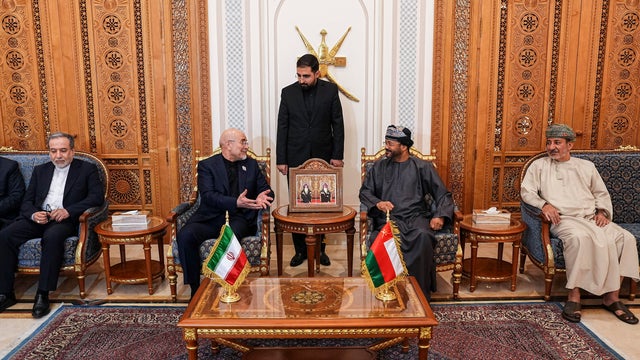
o A news outlet run by Iran's military said Thursday that Iranian and Omani officials have reached an agreement to open a temporary new shipping route through the Strait of Hormuz, but that the U.S. must lift its naval blockade and return to the terms of a previous truce for the plan to be implemented.
o Qatar's foreign minister visited Tehran Thursday for talks with his counterpart aimed at creating "suitable conditions for dialogue," amid a push by mediators Pakistan and Qatar to draw the U.S. and Iran back into direct negotiations to end the nearly six-month war. Qatar said the foreign ministers also discussed the emerging proposal by Iran and Oman to open a shipping route through the Strait of Hormuz.
o President Trump told Al Jazeera on Wednesday that the U.S. was "achieving a very big victory" against Iran, but that the war "will continue for as long as necessary" and there's no timetable to resume peace talks with Tehran.
46m ago
Trump says Iran is "begging to make a deal"
President Trump insisted Thursday that Iran is "begging to make a deal," as Iranian officials push back against the U.S. and talks between the two countries remain stalled.
"I don't want to meet, they do," he said in a Truth Social post that lashed out at a Fox News report.
Mr. Trump told reporters earlier Thursday his administration is "not looking to meet" with Iran, arguing the naval blockade on Iranian ports and ever-tightening sanctions on Iran's economy have inflicted severe damage on the country.
Publicly, Iranian officials have stood firm, vowing to keep the Strait of Hormuz closed to shipping traffic unless the U.S. returns to a temporary deal the two sides struck earlier this summer. Mr. Trump claims the strait is open, but ships have been hesitant to sail through the vital waterway.
Meanwhile, Qatar's foreign minister visited Tehran on Thursday and urged the two sides to "resume the diplomatic process."
6:37 PM
Pakistan, Kuwait reach deal to bolster Kuwait's military
Pakistan's military announced Thursday that it has agreed to assist Kuwait's military with training, capacity building and border management.
The Pakistani armed forces said the deal was signed by Kuwait's defense minister during a visit to the garrison city of Rawalpindi focused on bilateral defense relations and security cooperation.
Gulf states, long reliant on American protection, have been considering alternative security arrangements in the wake of the Iran war. In early August, Saudi Arabia signed a mutual defense pact with Pakistan and Turkey.
Pakistan said Thursday that it was also continuing diplomatic efforts with Iran, citing a recent visit to Tehran focused on reopening the Strait of Hormuz.
2:36 PM
Trump responds "Who says I'm not?" to question about whether he'll sanction Chinese banks
President Trump fired back at a reporter Thursday who asked whether the U.S. would institute sanctions on Chinese banks that cooperate with Iran, responding, "Who says I'm not?"
The president was asked about the potential punishment for China after officials in that country said they would not support U.S. sanctions on Iran. China is Iran's largest trade partner.
"Well, who said I'm not? You said, 'Why not?' I mean, who said I'm not?" Mr. Trump responded. "You don't know if I'm doing it. Well, I don't have to announce everything, do I?"
Treasury Secretary Scott Bessent said last week that China should "get with the program" in regard to sanctions during an interview with CNBC. However, Chinese officials called the sanctions "illegal" and "unilateral" and said they would not enforce them.
Bessent and Mr. Trump have called the sanctions unprecedented and said they will lead to the total economic isolation of the country. Iran has criticized the sanctions, but also said they've been preparing for the sanctions for two years.
2:13 PM
75 ships have been redirected in Strait of Hormuz by U.S. military blockade
There has now been a total of 75 ships heading into or exiting Iranian ports redirected by U.S. military blockade on the Strait of Hormuz, according to U.S. Central Command.
The update was the first since Monday, when CENTCOM said 71 ships had been redirected since the blockade went back into place on July 14.
President Trump again touted the blockade's effectiveness in a White House Oval Office event Thursday.
"The Strait of Hormuz is open. We have control and we have the blockade," Mr. Trump said. "Iran's not getting anything through. Nothing is getting through. Not one ship has gotten through."
1:55 PM
24 oil tankers traveled through Strait of Hormuz overnight with U.S. assistance, Trump says
Twenty-four oil tankers traveled through the Strait of Hormuz overnight with the assistance of the U.S. military, President Trump said during an unrelated executive order signing Thursday.
He said "millions and millions" of barrels of oil were taken out of the strait, and it was being done on a daily basis.
The president also continued to say the strait has been completely demined, and also said for the first time that the U.S. has taken out multiple boats laying mines in the waterway. Allies of the U.S. have reportedly said they do not believe the strait is demined, according to Bloomberg.
"We've totally cleared the strait of mines. … Any boat goes through with a mine, we take it out," Mr. Trump said. "And we've taken out two."
12:34 PM
U.S. Patriot missile stocks in Europe are "beyond critical" due to Iran war, officials say
The U.S. military is experiencing a "beyond critical" shortage of advanced missile interceptors in Europe largely driven by President Trump's war with Iran, a U.S. defense official in Europe and a NATO official told The Associated Press, raising concerns about vulnerabilities in NATO countries to a potential Russian attack.
The U.S. defense official said the most concerning shortfall involves Patriot missile interceptors, which can shoot down Russia's high-speed ballistic missiles. The NATO official confirmed the low inventories of Patriots among American and NATO forces in Europe. Both spoke on condition of anonymity to discuss sensitive military matters.
The shortage illustrates the cascading fallout from Mr. Trump's decision to launch a war against Iran, a conflict that reaches the six-month mark on Friday.
U.S. missile stocks in Europe have been moved to the Middle East, where U.S. and Gulf allies have fired off significant numbers of interceptors, including Patriots, to thwart Iran's drones and missiles. Some of those attacks have killed and wounded American troops.
12:11 PM
Qatar says foreign minister "stressed the need to resume the diplomatic process" at meeting in Tehran
Qatar's government said the Persian Gulf nation's Prime Minister and Minister of Foreign Affairs Sheikh Mohammed bin Abdulrahman bin Jassim Al Thani "stressed the need to resume the diplomatic process" during his meeting Thursday in Tehran with the Speaker of Iran's Parliament, who is also a senior member of the Iranian negotiating team.
"The two sides reviewed developments in the region and efforts to de-escalate tensions and create suitable conditions for the resumption of dialogue," the Qatari Foreign Ministry said in a statement.
The office of Iranian Parliament Speaker Mohammed Bagher Ghalibaf said in its own readout of the meeting that he had "confirmed" to Al Thani "that Washington is making wrong decisions based on misleading information."
Ghalibaf's office said he had told the visiting Qatari diplomat that "America must fulfill its obligations under the memorandum of understanding."
11:37 AM
Woman killed, 6 people wounded in Israeli strikes as fighting with Hezbollah continues, Lebanon says
Lebanon's ministry of health said a woman was killed and six other people wounded, including a girl, a woman and two elderly people, in Israeli airstrikes Thursday in or around the southern town of Arab Salim.
The Israel Defense Forces had announced airstrikes in southern Lebanon earlier, saying they targeted "Hezbollah infrastructure in the Nabatieh area" including purported weapons storage facilities belonging to the Iran-backed group that the IDF said had been "established in order to harm Israeli civilians" and soldiers.
"The strikes were carried out in response to the Hezbollah terrorist organization's actions overnight (Thursday) against IDF soldiers operating in the Ali-Taher Ridge within the Security Zone, in which they launched two explosive drones toward IDF soldiers. No IDF injuries were reported," the IDF said.
Despite a ceasefire brokered by the U.S., Israel has continued launching attacks on Hezbollah, always labeling them responses to Hezbollah truce violations, almost daily.
Israeli soldiers have occupied a section of southern Lebanon that extends some six miles from the country's shared border, calling it a "security zone" and expelling thousands of Lebanese residents.
Israel will not withdraw its forces, the country's political and military leaders say, until the threat posed by Hezbollah is eradicated.
The ongoing fighting between Israel and Lebanon has been a consistent thorn in the side of efforts by Pakistan, Qatar and others to broker a peace deal between the U.S. and Iran, which demands a halt to fighting on all fronts, including in Lebanon, as part of any peace agreement.
11:03 AM
Iran has executed over 500 people this year amid surge in hangings, rights group says
Iran has executed over 500 people so far this year after a new surge in hangings in recent days, despite President Trump urging the Islamic Republic regime to halt executions, a rights group said Thursday.
At least 511 people have been executed so far in 2026, according to Norway-based NGO Iran Human Rights, including at least 29 people in connection with anti-government protests in January. At least 16 women are among those executed and at least 13 "political prisoners" affiliated with banned opposition groups, it said.
Activists accuse Iran of using capital punishment as a means to intimidate the population in the wake of the protests and the war against the United States and Israel that erupted on February 28.
"All executions, regardless of the charges, have a clear domestic purpose - to create fear and prevent new protests," IHR director Mahmood Amiry-Moghaddam told AFP. "We are very concerned that this trend could worsen in the coming months."
Since wartime executions resumed on March 19, two people have also been executed in connection with the "Woman. Life. Freedom." protests that erupted in 2022.
Mr. Trump wrote on his Truth Social platform Tuesday that "the failing Islamic Republic of Iran is not paying large segments of their military, while at the same time killing protesters, even when they are not protesting, at levels not seen before."
"It is a humanitarian crisis of epic proportions, and must be stopped, NOW," he added.
10:30 AM
Oil prices inch back up slightly
The price of Brent crude oil, the international standard, climbed Thursday by about 0.5% to $87.36 per barrel.
It was trading around $72 a barrel in late February before the war in Iran began.
Benchmark U.S. crude rose 0.2% to $82.38 per barrel.
Oil prices have fluctuated during the war as markets try to interpret on-again, off-again diplomacy between the U.S. and Iran aimed at ending the conflict.
The White House says there are currently no direct talks underway, but Iran has indicated this week plans to propose a temporary measure, in conjunction with Oman, to reopen the vital Strait of Hormuz to commercial shipping traffic.
Efforts by mediating nations Qatar and Pakistan to revive direct diplomacy between Iran and the U.S., as the Trump administration announced new sanctions aimed at pressuring Tehran to accept a deal, had appeared to ease concerns in energy markets earlier in the week, with oil prices falling modestly for several days.
9:49 AM
Iran says damaged South Pars gas field coming back online, and oil sales continue, but "declined to some extent"
About 40% of the natural gas production capacity in Iran's South Pars gas field damaged during the war with the U.S. and Israel has been restored, Iran's Deputy Oil Minister Ahmed Zeraatkar was quoted as saying Thursday by Iran's Fars news agency, which is linked with the country's Revolutionary Guard Corps.
South Pars is the Iranian portion of the world's largest offshore natural gas field, which it shares with Qatar in the Persian Gulf.
Israel launched an attack on South Pars infrastructure just several weeks into the war, drawing an early rebuke from President Trump, who said the U.S. wasn't warned in advance, and declared there would be "no more" such Israeli attacks on the field.
Mr. Trump, in the same remarks in March, then threatened to "massively blow up" the South Pars field if Iran continued launching attacks on Qatar.
Iran's oil and gas production and sales have since been severely curtailed by the ongoing U.S. naval blockade of its ports, and by increasing sanctions against the Islamic Republic intended to force its leaders to capitulate and accept a peace deal favorable to Washington.
Iranian Oil Minister Mohsen Paknejad said Thursday that "the sale of our oil outside our territorial waters, in distant waters — meaning the delivery of oil to our customers — has continued" despite the U.S. blockade, but he acknowledged they had "declined to some extent."
"I don't want to go into the details because, in any case, this is information that, if disclosed, could be exploited by the enemy," Paknejad said.
9:11 AM
Pakistan sees momentum to reopen Strait of Hormuz, but says only Iran and U.S. can make the decision
Pakistan's government voiced optimism Thursday about an emerging proposal from Iran and Oman to reopen the Strait of Hormuz to shipping traffic, touting "momentum" in diplomatic efforts, but stressing that it would be down to a "sovereign decision that is to be taken in Tehran and Washington."
"There was indeed renewed efforts for the opening of the Strait of Hormuz," Pakistani Foreign Ministry spokesman Tahir Andrabi told reporters in Islamabad on Thursday, referring to the visit earlier in the week by Pakistan's army chief to Tehran. "We remain positive that some momentum will be generated towards this important aspect — the opening of the Strait of Hormuz — because it affects everybody with respect to the disruption of supply chains, particularly energy supply chains."
Noting "follow-up visits," including the Qatari foreign minister's meeting Thursday in Tehran with his Iranian counterpart, Adrbabi said "there are concerted efforts towards the settlement of this issue, particularly the opening of the Strait of Hormuz," but he stressed that in the end, it would come down to "a sovereign decision that is to be taken in Tehran and Washington."
Asked whether Pakistan would support an emerging agreement between Iran and Oman, as the two states with coastline in the strait, to open a temporary shipping channel if it involved the imposition of fees on commercial vessels, Andrabi declined to answer directly.
"This is part of the larger discussion," he said. "I would not like to comment on every specific aspect of this larger debate, i.e. the right to levy fees, the right to collect fees by the littoral states, and what the obligations are of the countries whose ships are passing by."
8:16 AM
Top Qatari, Iranian diplomats discuss creating "suitable conditions for dialogue" and emerging Strait of Hormuz proposal
Qatar's Foreign Ministry said the Persian Gulf state's top diplomat, during a meeting with his counterpart in Iran Thursday, discussed "efforts being made to de-escalate tensions and create suitable conditions for dialogue," amid a push by Qatar and Pakistan to revive U.S.-Iran peace negotiations.
Qatar's Sheikh Mohammed bin Abdulrahman bin Jassim Al Thani met Iranian Foreign Minister Abbas Araghchi in Tehran, and their "meeting also touched on the ongoing discussions regarding the proposed phased framework, which includes the establishment of a temporary joint navigational corridor through the Strait of Hormuz," the Qatari ministry said, referring to a proposal Iran and Oman have been crafting.
The Qatari ministry's statement said Al Thani stressed during the meeting, "the need to respect the sovereignty of neighboring states and respect freedom of navigation, affirming the importance of continuing diplomatic efforts to de-escalate tensions and address differences through dialogue."
7:46 AM
Iran parliament speaker: Country facing "all out economic war" as U.S. tries to foment internal division
Iranian Parliament Speaker Mohammad Bagher Ghalibaf called Thursday for national unity and support for the government, saying internal divisions would weaken Iran as the country faces an "all-out economic war."
In a message posted on his Telegram channel, Ghaliban said President Masoud Pezeshkian's government should prioritize people's livelihoods, purchasing power, youth employment and economic security while addressing the economic consequences of the war.
"Supporting the government does not mean turning a blind eye to its weaknesses, but trusting the government to serve the people better," he said.
Ghalibaf said Iranian officials had made effective efforts to manage the country's economic situation and address weaknesses, despite what he called the enemy's efforts to exert maximum pressure on the Iranian population.
He predicted, however, that the government and the wider Iranian state apparatus would ultimately win.
"The country is in an all-out economic war and, by the grace of God, we will see that the government and the executive apparatus, relying on the capabilities of the people, economic actors in the private sector and all the institutions of the system, will defeat the enemy in this arena as well," he said.
7:11 AM
Top Qatari and Iranian diplomats meet in Tehran amid efforts to revive U.S.-Iran talks
Qatar's visiting Prime Minister and Foreign Minister Sheikh Mohammed bin Abdulrahman bin Jassim Al Thani met Thursday with his counterpart Abbas Araghchi in Tehran, amid efforts by mediators Qatar and Pakistan to revive negotiations to end the war between the U.S. and Iran.
Photos shared online by Iran's Fars News agency, provided by the Iranian Foreign Ministry, showed the two men meeting in Tehran.
Iranian Foreign Ministry spokesman Esmaeil Baqaei said earlier that the visit was part of ongoing Iran-Qatar consultations aimed at strengthening bilateral relations and promoting peace and security in the region.
He said Al Thani would meet Iranian officials to discuss the continuation of Qatar's mediation efforts and initiatives, as well as other regional developments.
6:04 AM
Iran news outlet says agreement reached with Oman on temporary Strait of Hormuz corridor - but all depends on U.S.
Iran and Oman have reached an understanding on a temporary joint maritime corridor to enable commercial shipping to resume through the Strait of Hormuz after several weeks of consultations, the Iranian armed forces' Defa Press outlet reported Thursday.
It stressed that the agreement did not mean the immediate reopening of the strategic waterway, and Iranian officials said Wednesday that a previous agreement reached with Oman had effectively been rejected by the U.S.
Under the new proposal, vessels entering the Persian Gulf from the Gulf of Oman to the south would travel entirely through Iranian territorial waters, and part of the outbound route would also pass through Iranian waters.
The corridor would consist of two-way shipping lanes separated by approximately two nautical miles, with a total width of around seven nautical miles, including the lanes and separation.
Defa said the route was established following technical and expert assessments by Iranian and Omani officials, with the intention being to eventually replace the temporary corridor with a permanent maritime traffic scheme following further Iran-Oman negotiations.
For Tehran, a key element of the proposal is the formal closure of the southern route through the strait, in Omani internal waters, which the U.S. has urged commercial vessels to use for the past couple months. Iran considers that route inconsistent with the memorandum of understanding signed with the U.S.
If the new arrangement is implemented, the southern route would be formally closed and the change notified to the International Maritime Organization. Iran and Oman would then negotiate a replacement for the pre-war maritime traffic separation scheme, which has been in place for about 58 years. Those negotiations could take 30 to 60 days, according to Defa.
The report stressed that the reopening of the Strait of Hormuz remained conditional, according to Iran, on the U.S. fulfilling its commitments under the previous MoU, which called for a halt to all threats and military operations. Iran insists the U.S. must, under the terms of the currently-mothballed deal, lift its naval blockade of Iran's ports and vessels, release frozen Iranian state funds, impose no new sanctions and refrain from increasing the U.S. military deployment in the region.
According to Defa, Iran wants those commitments to be visible and verifiable before it takes reciprocal action, including implementing the tentative agreement with Oman over control of the strait.
4:58 AM
Iran confirms Qatari prime minister visiting amid efforts to revive U.S.-Iran diplomacy
Iran confirmed Wednesday that Qatari Prime Minister and Foreign Minister Sheikh Mohammed bin Abdulrahman bin Jassim Al Thani was to visit Tehran as Doha seeks to help revive diplomacy between Iran and the United States.
Iranian Foreign Ministry spokesman Esmaeil Baqaei said the visit was part of ongoing Iran-Qatar consultations aimed at strengthening bilateral relations and promoting peace and security in the region.
Baqaei said Al Thani would meet Iranian officials to discuss the continuation of Qatar's mediation efforts and initiatives, as well as other regional developments.
Iranian Foreign Minister Abbas Araghchi said in a social media post Tuesday, after a visit by a senior delegation led by Pakistan's army chief, that "Iran's commitment to peace and stability is matched by steadfast diplomacy with our neighbors. In talks with Pakistani and Omani guests, regional solutions were stressed."
3:49 AM
Iran concedes U.S. blockade leaving it short on oil
Iran hasn't been able to import enough oil to make up for insufficient domestic production due to the U.S. naval blockade, a senior Iranian official said.
"Petrol production is insufficient, and because of the U.S. naval blockade, we cannot import it," the official IRNA news agency quoted Vice President Mohammad Jafar Ghaempanah as saying.
The remarks came as Iranians have in recent days lined up outside gas stations, with the war with the United States increasingly shifting toward economic pressure on Tehran.
On Monday, the Iranian president's chief of staff, Mohsen Haji-Mirzaei, said oil quotas would be reviewed, without elaborating.
War broke out between Iran and the United States on February 28. Tehran seized control of the strategic Strait of Hormuz, and Washington countered with a naval blockade on Iranian ports.
Ghaempanah criticized the distribution of highly subsidized fuel in Iran, saying the current system disproportionately benefits people who own multiple vehicles.
"The distribution of petrol in the country is inequitable. Owners of several vehicles benefit from subsidies, unlike those who do not own one," he said.
Iran, a major oil producer with some of the world's cheapest fuel, has for years heavily subsidized oil purchases, making any changes to pricing politically sensitive.
1:53 AM
Tanker in Strait of Hormuz hit by "unknown projectile," British military says
An "unknown projectile" struck a tanker in the Strait of Hormuz this week, causing a fire that has since been put out, a British military maritime agency said early on Thursday.
Iran has effectively blockaded the Strait of Hormuz since the United States and Israel attacked the Islamic Republic in late February.
Tehran wants to charge tolls for passage, and has attacked ships it accuses of trying to skirt its preferred route.
"Local authorities have reported a tanker has been hit by an unknown projectile, causing fire to the vessel which has since been extinguished," the United Kingdom Maritime Trade Operations (UKMTO) said.
The incident occurred near the Omani coastal city of Khasab and was reported to the UKMTO on Tuesday, the agency said.
There were no casualties among the crew and no adverse environmental impact, it said, adding that authorities are investigating the cause.
The online notice didn't specify the vessel's nationality or direction of travel.
Source
Posted by Temmy
Fri, August 28, 2026 12:58am
| Top |
|
For enquiries, notifications and ad placement send mail to worldnewsservice2025@outlook.com Copyright 2019 - 2026 All Rights Reserved. Privacy Policy || Terms & Conditions |