
News Topic
Iran lauds ties with Russia, contradicting Trump's claim of little Russian support for Tehran
What to know about the Iran war today:
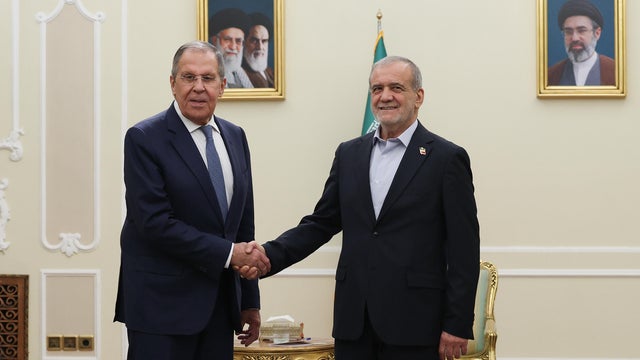
o Iran's foreign minister said Tuesday that Tehran's ties with Russia had never been so close, after President Trump said Moscow was "doing very little, if anything, to help" Iran amid the war in the Middle East. Russia's foreign minister, on his first visit to Tehran this week since the outbreak of the war, called U.S. and Israeli attacks on Iran illegal.
o Israeli Prime Minister Benjamin Netanyahu shared a video Monday on social media of a phone call with Mr. Trump during which he suggests possible new joint U.S.-Israeli strikes on Iran, telling the American leader they have "a job to finish."
o U.S. Secretary of Defense Pete Hegseth met with Netanyahu on Monday during an unannounced visit to Israel, according to two sources familiar with the matter.
4:44 PM
Hegseth says he met with Netanyahu in Israel
Defense Secretary Pete Hegseth confirmed Tuesday that he visited Israel on Monday and met with Prime Minister Benjamin Netanyahu, saying he "was there visiting our troops" and "had a chance to talk to the prime minister."
The unannounced visit came just over a week before Netanyahu's party faces elections. It also comes after President Trump floated resuming military operations against Iran following next month's U.S. midterm elections.
"Of course, the nature of our conversations is not something I would talk about but they've been good partners and I appreciate that," Hegseth said of his meeting with Netanyahu.
3:53 PM
U.S. ramps up warnings to Americans in Middle East after deadly Houthi strikes
U.S. diplomatic missions across the Middle East have issued a new round of security warnings to Americans amid escalating attacks by Iran-backed Houthi militants against Saudi Arabia, including an Oct. 10 strike on Riyadh's international airport that killed an American citizen.
The alerts, issued Sunday by U.S. embassies in Saudi Arabia, Bahrain, Qatar, the United Arab Emirates and several other countries, warned that hostilities could rapidly and without warning spread beyond areas already affected by the fighting. The advisories urged Americans to exercise vigilance and prepare for possible flight cancellations, airspace closures and other travel disruptions.
"We are actively warning U.S. citizens about the very real threat the Houthis pose and urging them to heed official guidance," Edgar Vasquez, the State Department's deputy assistant secretary for press, told CBS News.
"These alerts are part of a proactive effort by the Trump administration to ensure Americans are aware of potential risks," Vasquez said, adding that the safety and security of American citizens remain the department's "top priority."
3:00 PM
Trump says he's deciding how to win Iran war: "We're doing very well with Iran"
President Trump said the U.S. is "doing very well with Iran" and he's just deciding how he wants to win the war.
"As you know, we're doing very well with Iran," Mr. Trump said as he took questions from reporters in the Oval Office at an unrelated executive order signing. "We just have to make a final decision of which way do we want to win? Do we want to win the nice way or the not nice way? But we're doing very well."
The war, which Mr. Trump said would take only a few weeks in March, has now dragged on for almost eight months with no apparent end in sight. Iran said on Tuesday it would not return to the negotiating table unless the U.S. drops its sanctions, threats and pressure campaign — an unlikely demand.
The president also discussed Europe not helping the U.S. with the war with Iran, saying, "We don't need any help. But I was testing them."
"I just called individual presidents and prime ministers to ask, would they like to help us? And they said, 'No,'" Mr. Trump said. "I said, 'Well, that's not nice.' You know, we spend hundreds of billions a year on NATO. And they said no."
2:48 PM
U.S. must stop threats, pressure campaign before return to talks, Iran says
Iran is taking a hard-line stance on negotiations with the U.S. to end the war, with President Masoud Pezeshkian saying Tuesday there will be no return to talks without a halt to the pressure campaign by the U.S.
Pezeshkian met with representatives from Pakistan, including army chief Asim Munir, on Tuesday. Pakistan has played an integral role as a mediator in peace talks between the U.S. and Iran, including the brief success of the Islamabad Memorandum in June.
"(Pezeshkian) told Pakistan's Field Marshal Asim Munir that US warmongering lies behind regional tensions, including disruptions in the Strait of Hormuz," according to a readout of the meeting from the official Iranian government account on X. "He said Washington must lift its pressures, threats and sanctions before any negotiations."
Those conditions are unlikely to be agreed upon by the U.S., which has stepped up its sanctions, dubbed Operation Economic Outcast, over the past month. President Trump has said the economic pressure campaign has become the main strategy for ending the war.
Pezeshkian also met with Russian Foreign Minister Sergey Lavrov in Tehran on Tuesday. Iran and Russia have become powerful allies.
2:32 PM
3rd tanker hits mines crossing Hormuz strait, IRGC says
Naval mines have halted three tankers attempting to travel the Strait of Hormuz via routes considered illegal by Tehran, Iranian Revolutionary Guards said on Tuesday.
"Two violating oil tankers were set ablaze and halted due to the explosion of mines planted by the brave sailors of the IRGC Navy at an illegal crossing point in the southern part of the Strait of Hormuz," the Guards said in an earlier statement on their official Sepah News website.
The Guards later said in a statement carried by state TV that a third oil tanker "exploded and caught fire after striking a naval mine south of the Strait of Hormuz."
The tanker "carrying over 2 million barrels of crude oil, had deactivated all of its radar and navigation systems," the statement added.
Iranian forces have, since the outbreak of the Middle East war, repeatedly targeted ships attempting to pass through Hormuz via a southern, U.S.-approved route close to the Omani coast.
President Trump has said on several occasions that the Strait of Hormuz has been cleared of all mines.
2:08 PM
Iranian security chief rejects moving enriched uranium out of country
Iran's security chief, Mohsen Rezaei, on Tuesday told visiting Pakistani army chief Asim Munir that Tehran will not allow nuclear material to leave the country, according to state TV.
"Not even a tiny bit of enriched nuclear material will leave Iran. Such materials constitute a major asset and national wealth for the Iranian people, intended for use within the country," said Rezaei, secretary of Iran's Supreme National Security Council.
"There will be no negotiations until America takes steps to build trust — a process that must begin with the fulfillment of Iran's conditions."
President Trump has made preventing Iran from obtaining a nuclear weapon the administration's top priority.
"They can't have a nuclear weapon," Mr. Trump said Monday night at a rally in Kansas. "OK, and they won't. By the way, somebody said you could leave right now. It's true. We can leave right now. They're not going to have a nuclear weapon."
1:51 PM
Iran calls for emergency U.N. Security Council meeting over alleged bombing threat by U.S.
Iran's envoy to the U.N., Gholamhossein Darzi, sent a letter to United Nations Secretary-General Antonio Guterres on Tuesday detailing concerns over the potential use of the so-called "Mother of All Bombs" by the United States if the war with Iran restarts after the midterms, according to state-run ISNA news.
"I wish to draw your immediate attention, as well as that of the members of the Security Council, to the recent brazen existential threats made by the President of the United States regarding the possible use of the GBU-43/B bomb, officially known as the Massive Ordnance Air Blast (MOAB), also referred to as the "Mother of All Bombs," against Iran, as well as the renewed threats by the Israeli regime of military aggression and its declared intention to target all of Iran's energy infrastructure," Darzi wrote in his letter, according to state-owned media.
The letter from Darzi asks for Guterres and the head of the U.N. Security Council to convene a meeting and highlights four demands from the 15-country group, which permanently includes the U.S., China, Russia, France and the U.K.
Iran asks for the security council to call upon the U.S. and Israel to end their "unlawful threats" toward Iran; explicitly and unequivocally condemn threats to attack Iran; address threats to regional peace; and ensure accountability and reparations for damage from "wrongful acts committed by the United States and the Israeli regime against Iran."
"Threatening to use the 'MOAB' bomb (the Mother of All Bombs) against Iran's civilian infrastructure and to target all of the country's energy infrastructure constitutes, among other things, a flagrant violation of international law," Darzi wrote.
1:33 PM
Israel says army will remain in Lebanon until Hezbollah disarms, warns of further territorial seizures
The Israeli army has no plans to leave southern Lebanon anytime soon and may in fact take over more territory, according to Defense Minister Israel Katz.
"The IDF will not move out of the security zone as long as Hezbollah has not been disarmed throughout Lebanon — and the threat to the residents of the north has not been removed," Katz said on social media.
Katz also threatened to bomb part of Beirut every time an attack drone or missile was launched toward Israeli cities or kibbutzim in the north.
"We are pursuing a determined policy stipulating that any shooting or launch of drones and UAVs toward Israeli cities, moshavim, or kibbutzim will be met with a powerful response against the Dahiyeh district in Beirut," Katz said.
While Katz did say the army was willing to take more than the 700 square kilometers already below the Israeli-designated Yellow Line, it said the army would only do so if there was a coordinated attack from Iran.
"If Hezbollah joins an Iranian attack on Israel, it will be dealt a severe blow, and the IDF is prepared to carry out a ground maneuver into additional areas around Nabatieh and the Litani River," Katz said. "The territory that is captured will be evacuated of its residents, dealt with in the same manner, and permanently made part of Israel's security zone in Lebanon."
1:11 PM
Qatar, Pakistan propose compromise to revive U.S.-Iran nuclear talks, Qatari outlet says
Qatar and Pakistan have presented Washington and Tehran with a compromise proposal aimed at preventing renewed escalation and bringing the two sides back to the negotiating table, Qatari outlet Al-Araby Al-Jadeed reported, citing informed sources.
The initiative was met with U.S. approval and a positive response from Iran, the outlet reported.
The proposal was conveyed to Iranian officials by Pakistan's army chief Field Marshal Asim Munir, who arrived in Tehran on Tuesday at the head of a delegation of Pakistani officials, according to the report.
The suggested arrangement includes a partial response to Iran's demand for the release of frozen assets. Under the initiative, Iran would receive interest generated by $6 billion in Iranian funds frozen in Qatari banks, the sources said.
In return, Tehran has reportedly agreed to an undisclosed visit by the International Atomic Energy Agency to Iranian nuclear sites, addressing a key U.S. demand concerning Iran's nuclear program.
The sources said a potential breakthrough could be announced this week.
12:43 PM
Iran pursues legal action over U.S. torpedo attack that sank warship
An Iranian military official said Tuesday that Tehran is pursuing legal action over the U.S. torpedo attack on the IRIS Dena warship, arguing the vessel was not a legitimate military target.
In early March, Defense Secretary Pete Hegseth said a torpedo launched from a U.S. Navy submarine had sunk an Iranian warship in the Indian Ocean "that thought it was safe in international waters."
"Instead it was sunk by a torpedo — quiet death," Hegseth said. It was the first time a U.S. Navy submarine had used a torpedo to sink a warship since 1945.
The strike killed more than 80 Iranian service members.
In an interview with Iranian state TV on Tuesday, Brig. Gen. Moslem Yaghoubi, the Iranian army deputy for legal affairs, said the vessel was an unarmed training ship carrying trainees and that it was hit about 1,200 miles from the battlefield.
"Just this one point is enough to establish that striking it was militarily unnecessary," he said.
Iranian Foreign Minister Abbas Araghchi said in June that Iran was collating documents related to the incident for what state media described as "legal follow-up," but Tehran has not specified a court in which it intends to file its legal action.
12:02 PM
Saudi Arabia says Houthi drone and missile intercepted Tuesday
Saudi Arabia said Tuesday it had intercepted a drone targeting Riyadh, as well as a missile it previously said was taken down.
Maj. Gen. Turki Al-Maliki, spokesman for the Saudi-led coalition fighting in Yemen, said on X that a drone had also been intercepted and destroyed, without specifying who was believed to have launched it.
The bulletin came after the country's Civil Defense said earlier that people in the Riyadh area should "avoid crowds or going to dangerous areas, and refrain from taking photos" in a post on X, before saying the danger had passed.
Shortly after, Al-Maliki said a ballistic missile launched by the Iran-backed Houthis at Riyadh had been "intercepted and destroyed."
10:58 AM
France secures 200,000 tons of extra diesel per month from UAE, Bahrain
French President Emmanuel Macron has secured the delivery of an additional 200,000 tons of diesel per month from the United Arab Emirates and Bahrain during a tour of the Persian Gulf, the French presidency said Tuesday.
He obtained commitments for around 100,000 tons per month from the UAE, and an additional 100,000 tons from Bahrain, the French Elysee presidential palace said, according to the AFP news agency.
With the addition of deliveries from Saudi Arabia, France has commitments for 295,000 tons per month, representing just over 10% of its consumption, the statement added.
Macron is undertaking a tour of key energy suppliers in the Gulf in an effort to secure oil and diesel and bring down prices in France after a weekend of violent protests over soaring living costs and other social issues.
The G7 countries, chaired this year by France, agreed in early October to release up to 100 million barrels of oil from their strategic reserves to ease pressure on global fuel supplies amid the U.S.-Iran war.
The shipments for France will be sent overland via Oman, bypassing the Strait of Hormuz, the French presidency said. Experts have questioned whether the deliveries will have an impact on prices in France, however, given the risk of renewed fighting in the region.
10:09 AM
Iran's armed forces chief says Tehran won't wait for U.S. midterm elections to respond to any new U.S. attack
Iran's Chief of Staff of the Armed Forces warned Tuesday that Tehran would not wait for the U.S. midterm elections before retaliating to any new U.S. attack.
Maj. Gen. Abdollahi said Iran "has not waited, nor will it wait, for the results of the U.S. congressional elections" to respond to any new attack.
He blamed regional insecurity on the presence of U.S. forces and warned countries hosting American troops to remain vigilant.
"Countries hosting the United States in the region should also know that the main cause of insecurity in the region is the presence of the terrorist U.S. military," he said.
8:48 AM
U.K. to carry out defensive air patrols over Saudi Arabia
The U.K. government announced Tuesday that it is expanding military support for Saudi Arabia as it faces ongoing attacks by the Iran-backed Houthi rebels in Yemen, including "defensive" air patrols by British Royal Air Force jets over the kingdom.
Defense Secretary Wes Streeting said Royal Air Force Typhoon jets would "conduct defensive counter-air operations over Saudi Arabia, helping to protect Saudi cities, civilian populations and critical national infrastructure from Houthi attack."
He said British planes would not strike Houthi targets in Yemen.
The U.K. will also send a military transport plane and an unspecified number of military advisers to Saudi Arabia, Streeting said.
The announcement follows Britain's decision last month to offer in-air refueling of Saudi planes operating against the Iran-backed rebels. That mission is being extended by another 90 days, Streeting said.
8:16 AM
Death toll from Houthi attack on Yemeni military training camp rises to 73
The death toll from a Houthi missile strike on a government military camp in southern Yemen rose to 73 people Tuesday, making it the deadliest strike since fighting in the country began escalating three months ago, a senior Yemeni government official said Tuesday.
The recruits were all aged between 18 and 20, and some were still missing a day after the Iran-backed Houthis hit the al-Alam camp in the southern province of Shabwa with ballistic missiles, according to provincial governor Awad Ibn al-Wazir.
7:29 AM
Qatar says Iran and U.S. still engaging, warns new escalation would push war "beyond the borders of our region"
Negotiations between Iran and the United States are ongoing despite rising tension and repeated statements from President Trump that the U.S. could resume major strikes on Iran next month, Qatari Foreign Ministry spokesman Majed al-Ansari said Tuesday.
"The negotiation is ongoing. We are seeing engagement from the parties," al-Ansari, who also serves as an adviser to Qatar's prime minister, said at the Global Security Forum in Doha on Tuesday.
Al-Ansari did not offer any further information on the negotiations, including whether there have been any recent direct contacts between Iranian and U.S. officials or if the talks are being conducted entirely via mediators.
He said discussions were continuing with regional partners and expressed hope that diplomatic efforts would eventually lead to an agreement, while cautioning that conditions on the ground were becoming increasingly difficult.
"Escalation left unchecked will mean that we are spiraling towards a regional war that will expand beyond the borders of our region," he warned.
6:42 AM
Iran claims to have downed another U.S. MQ-9 drone and stopped 2 tankers in Strait of Hormuz with sea mines
Iran's military said Tuesday morning that it had destroyed another U.S. MQ-9 Reaper drone and attacked two more tankers in the Strait of Hormuz, causing fires on the unnamed ships.
In a statement, Iran's Islamic Revolutionary Guard Corps (IRGC) claimed to have struck and destroyed an MQ-9 drone over the Strait of Hormuz.
At least 24 American MQ-9 Reapers, two MQ-1 drones and an MQ-4C Triton have been lost since the U.S. began its war with Iran, representing a loss of more than $800 million, according to a report released by the Congressional Budget Office in September.
The IRGC also claimed two oil tankers trying to transit the Strait of Hormuz without Iran's permission, using a southern route endorsed by the Trump administration but not recognized by Tehran, were hit by sea mines laid by the IRGC, forcing them to halt due to fires on board.
Iran has routinely targeted vessels in and near the strait for months, challenging Trump administration assertions that the vital shipping lanes are open to commercial traffic and that the U.S. military has complete control of the waterway.
At the end of August, President Trump himself declared the strait mine-free, saying U.S. forces had "totally cleared the strait of mines … Any boat goes through with a mine, we take it out."
The U.S. Navy has also struck vessels in the region as part of its own blockade of Iranian ports and associated vessels.
6:10 AM
Pakistani army chief expected to visit Iran
Pakistan's army chief Asim Munir, a central figure in the country's efforts to mediate between Iran and the U.S., was expected to return for a new visit to Tehran on Tuesday, but Iran played down any hope for new wider peace talks.
Iranian foreign ministry spokesman Esmaeil Baqaei said talks with Munir "relate to issues concerning the negotiations, but they are mainly focused on bilateral relations and strengthening interactions and cooperation."
The visit comes a day after Russian Foreign Minister Sergey Lavrov made his first visit to Tehran since the U.S. launched its war with Iran.
Lavrov said his visit was "aimed at preventing the return of a large-scale war," and he called the U.S. and Israeli strikes on Iran illegal.
5:48 AM
Saudi forces say Houthi ballistic missile targeting Riyadh intercepted
Saudi forces intercepted a ballistic missile that was targeting the kingdom's capital, a military spokesman said Tuesday, after authorities issued a warning for people in Riyadh to take shelter.
The kingdom "intercepted and destroyed a ballistic missile launched by the terrorist Houthi militia towards Riyadh," Turki Al-Malki said in a post on X.
Riyadh has been targeted repeatedly by the Iran-backed Houthi rebels in Yemen for weeks. Attacks on two major airports, most of them directed at Riyadh's King Khalid International, killed 20 people in one week earlier this month.
5:12 AM
Israeli military accuses Lebanon of working with Iran-backed Hezbollah
The Israeli military accused the Lebanese army on Tuesday of working with the Iran-backed Hezbollah militant group in the country's south.
In a statement, the Israel Defense Forces said the Lebanese army "assisted efforts to prevent, delay, or thwart enforcement operations and enabled Hezbollah to prepare in advance to remove and transfer weapons from the area."
The Israeli military cited a weapons storage "asset" in Kfarra, in southern Lebanon, which it said was identified in December 2025 and flagged to Lebanese forces. The IDF said several months later, Hezbollah was still operating at the site, despite the Lebanese army claiming to have "addressed" it.
The IDF cited a 2024 ceasefire agreement between Israel and Lebanon that called for the Lebanese army to act "against the presence of weapons and military infrastructure belonging to the Hezbollah terrorist organization in southern Lebanon."
Under that agreement, Israel was to begin transferring control of "pilot zones" in the south to Lebanese state forces in July.
The plan faced early issues, with Lebanon accusing Israeli forces of firing at its troops, while Israel said it only fired warning shots.
After a shaky start in late July, President Trump's senior Middle East adviser, Massad Boulos, told reporters "things are progressing" with the pilot zone plan, which he called a "brilliant concept."
There has been little indication of meaningful progress on the transfer of territory occupied by Israeli troops in southern Lebanon - in a "security zone" that stretches about six miles into Lebanese territory - back to Lebanese forces since the summer.
1:51 AM
Iran signals closer ties to Russia
Iranian Foreign Minister Abbas Araghchi said Tuesday that Russia and Iran have never worked so closely, as Moscow seeks to present itself as a possible mediator in the Middle East war.
Araghchi hosted his Russian counterpart Sergey Lavrov in Iran on Monday — the veteran Russian diplomat's first visit to Iran since the U.S. and Israel launched joint strikes on the Islamic republic at the end of February, sparking the war.
"We covered everything from Europe to West Asia, including Lebanon, Palestine, Ukraine and Yemen. Also focused on expansion of economic and nuclear cooperation," Araghchi wrote on X. "Never in our history have Iran and Russia worked as closely as now."
Lavrov said ahead of his visit that Moscow's efforts were "aimed at preventing the return of a large-scale war," with talks stalled between the United States and Iran.
On Sunday, President Trump said in a Truth Social post that "Russia is doing very little, if anything, to help the Islamic Republic of Iran."
Mr. Trump has in recent weeks controversially eased U.S. sanctions against Russia, imposed over Moscow's ongoing full-scale invasion of Ukraine, in a bid to bring down fuel prices for Americans.
11:53 PM
Hegseth makes unannounced trip to Israel
Defense Secretary Pete Hegseth quietly visited Israel on Monday and met with Prime Minister Benjamin Netanyahu, according to a senior U.S. military official who spoke to CBS News under condition of anonymity because they were not authorized to speak publicly.
The unannounced visit came just over a week before Netanyahu's party faces elections. It also comes as President Trump floats resuming military operations against Iran after next month's U.S. midterm elections.
Hegseth confirmed in an X post that he was in U.S. Central Command's area of responsibility on Monday, sharing a photo of himself addressing American service members who he said were "on a historic mission." He did not specify his location or mention Israel.
The Pentagon declined to comment on the visit.
Source

Posted by Temmy
Wed, October 21, 2026 12:54am
| Top |
|
For enquiries, notifications and ad placement send mail to worldnewsservice2025@outlook.com Copyright 2019 - 2026 All Rights Reserved. Privacy Policy || Terms & Conditions |